

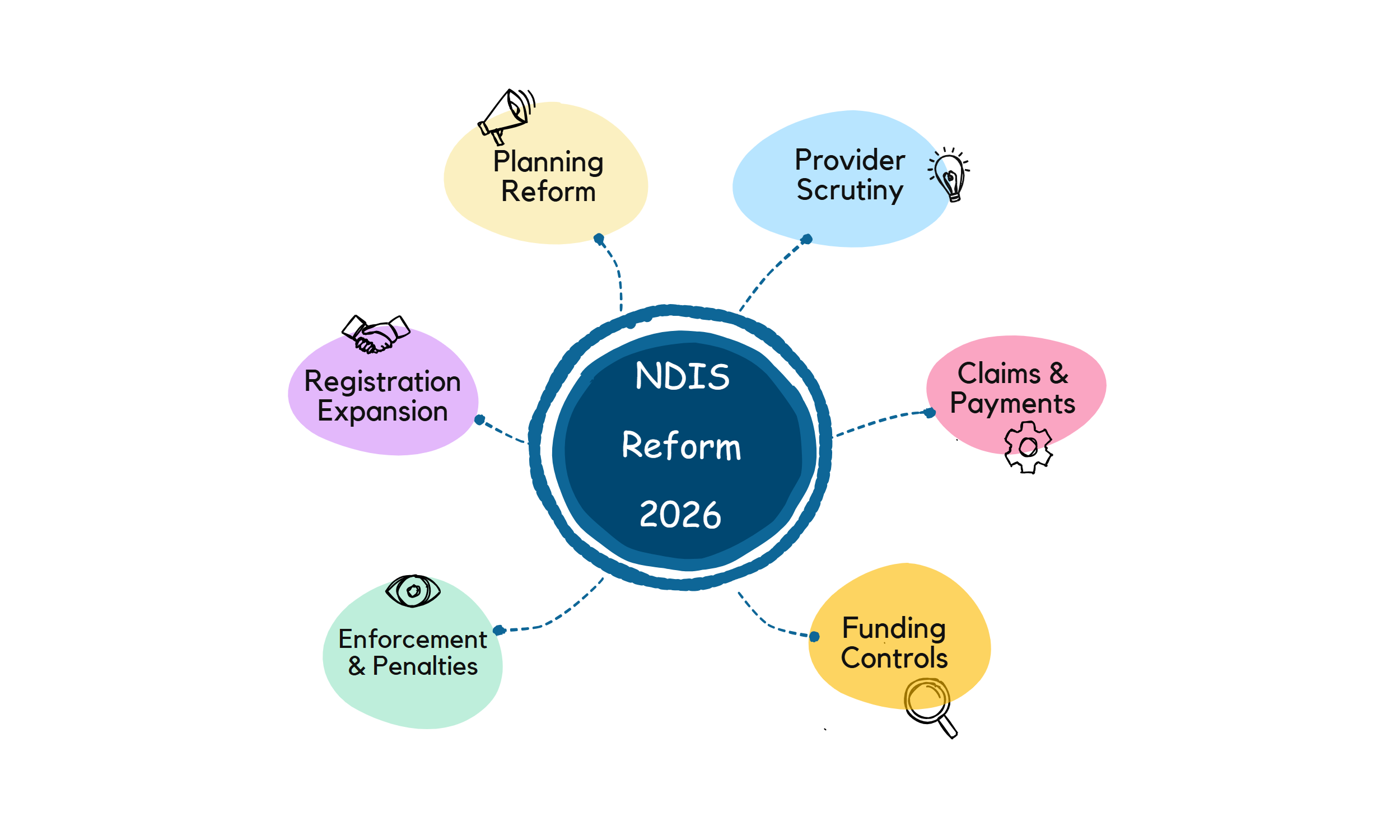
Therefore, we recommend you check this blog frequently for any future updates. Last Updated on 1/6/2026.
Introduction
The NDIS reform is no longer a future concept—it is actively reshaping how providers operate across Australia in 2026.
For NDIS providers, the focus is no longer just on understanding the reforms. The priority now is implementation, compliance readiness, and operational alignment.
These changes are driving a more regulated, structured, and evidence-based environment, where providers must demonstrate not only service delivery, but clear justification, documentation, and accountability.
For Supported Independent Living (SIL) providers and NDIS digital platform providers, this is now a time-critical issue. From 1 July 2026, mandatory registration requirements apply to these higher-risk service models, with new SIL-specific Practice Standards commencing on that date as well.
Background to the NDIS Reform
The Australian Government has already commenced legislative changes to the NDIS Act. Several changes took effect from 3 October 2024, while other reforms will be introduced progressively as new rules, systems, and transition arrangements are developed.
Here is the journey so far, and what is still ahead.
- 2023 – Independent NDIS Review identifies major structural issues
- 2024 – Legislative amendments to the NDIS Act introduced
- 2025 – New funding rules, claim frameworks, and plan controls begin rollout
- 2026 – Active transition phase – Mandatory registration for SIL and NDIS digital platform providers from 1 July 2026, new SIL Practice Standards, tighter funding controls, increased scrutiny, and expanding registration requirements
- Late 2026 & 2027 – further legislation, staged regulatory reform, broader high-risk provider registration work, and continued review of the NDIS Practice Standards
Key NDIS Reform Changes Affecting Providers in 2026
1. Stricter Definition of NDIS Supports
Providers must ensure all services:
- Clearly align with funded supports
- Are correctly linked to participant goals
- Can be justified under NDIS support rules
Risk: Claims outside the scope may be rejected or investigated.
2. Funding Periods and Budget Controls
NDIS plans now include structured funding periods (commonly quarterly). This means:
- Claims must align with time-bound budgets
- Over-servicing early in a plan creates compliance risks
- Providers must track utilisation more closely
Operational impact: Cash flow, rostering, and service scheduling must be tightly managed.
3. Increased Oversight on Claims and Payments
The claims framework is now more defined and enforceable. Providers must ensure:
- Accurate timesheets and service records
- Supporting evidence for every claim
- Timely submission (within allowable periods)
Audit reality: If it’s not documented, it didn’t happen.
4. Shift Toward Risk-Based Provider Registration
The reform direction is more targeted and risk-based. Mandatory registration is initially being expanded to higher-risk service models, including Supported Independent Living (SIL) and NDIS digital platform providers. Support Coordination remains a reform priority, but mandatory registration has been paused while the regulatory model is considered.
This will be based on:
- Risk level of supports
- Complexity of services
- Participant vulnerability
- Whether the provider is managing and coordinating higher-risk service delivery models
High-priority groups include:
- Supported Independent Living (SIL) providers: providers delivering NDIS-funded SIL supports that meet the new SIL definition, whether previously registered or unregistered.
- Platform-based service providers: NDIS digital platforms that connect participants with supports and process NDIS plan payments through the platform.
- Support Coordination providers: Mandatory registration has been paused, but the area remains under regulatory consideration.
5. Mandatory SIL Registration and New Registration Group 0138
From 1 July 2026, providers delivering SIL must be registered to do so. A new registration group has been created specifically for SIL: 0138 – Assistance with Supported Independent Living.
Existing registered providers delivering SIL under registration group 0115 are expected to have registration group 0138 added through a registration variation process. Providers that do not wish to deliver SIL should use the Commission process to notify that they do not wish to be registered for SIL.
Unregistered providers already delivering SIL must apply for registration by 1 October 2026 to continue delivering SIL during the transition. Providers that start delivering SIL after the commencement of the new requirements must be registered before delivering SIL.
Providing SIL without registration is a serious compliance risk and may expose the provider to enforcement action and penalties.
6. Distinguishing 0115, 0138 and Other Home and Living Supports
A key documentation issue is that registration group 0115 should no longer be treated as a simple substitute for SIL. Providers and consultants must describe the actual service model being delivered.
The provider’s documentation should clearly identify whether the provider delivers SIL, STA, MTA, ILO, or other in-home supports, because not all 0115-type supports automatically become SIL.
| Support/abbreviation | Meaning | Likely treatment under the reform |
|---|---|---|
| SIL (Support Independent Living) | A package of home and living supports for people with higher support needs, where the provider manages and delivers supports for a participant who needs support all or most of the day. | 0138 – Assistance with Supported Independent Living |
|
STA (Short-Term Accommodation and Assistance) |
Temporary accommodation and related support provided for a short period, usually to give the participant a change of environment, provide short-term support away from their usual home, or support respite-style arrangements. | Generally remains under 0115 / not automatically SIL. |
| MTA (Medium-Term Accommodation) | Temporary transitional accommodation provided for a limited period while a participant is waiting for a more permanent housing or support arrangement to become available. | Generally remains under 0115 / not automatically SIL. |
| ILO (Individualised Living Options) | a flexible home and living support arrangement designed around how and where a participant wants to live, focusing on planning, setting up and maintaining a personalised living arrangement rather than providing a standard shared-living support package. | Generally remains under 0115 / not automatically SIL. |
| Other In-home Supports | Supports that do not meet the SIL definition, such as a few hours of support per day or week, or participant-directed/self-managed worker arrangements. | Not 0138 unless the SIL definition is met; may remain under 0115 or other applicable support categories depending on the service model. |
7. New SIL Practice Standards
From 1 July 2026, registered SIL providers need to comply with the new SIL Practice Standards. These are expected to operate as a supplementary module alongside the NDIS Practice Standards Core Module.
The new SIL Practice Standards focus on the quality and safety of support delivered in a person’s home, including participant voice, rights, freedoms, choice and control, supported decision-making, dignity of risk and frontline worker practice.
Providers should be prepared to demonstrate compliance at their next mid-term audit or registration renewal audit after 1 July 2026.
8. New Planning Framework and Stronger Evidence Expectations
From 2026 onwards, providers should expect stronger evidence expectations across planning, claiming and service delivery. Providers should avoid relying on broad descriptions of support and should maintain clear records that demonstrate assessed need, participant goals, service delivery, risks, consent, participant choice and outcomes.
What this means for providers:
- Less flexibility in interpreting supports
- Greater need to align services with assessed needs
- Increased documentation expectations
- Greater need to demonstrate how participants are involved in decisions about their supports, home life, risks, routines and goals
What This Means for NDIS Providers Today
The environment in 2026 can be summarised in one sentence:
NDIS is moving from a trust-based model to an evidence-based system.
Providers must now demonstrate:
- Compliance with the NDIS Practice Standards
- Clear and structured documentation
- Strong governance and internal controls
- Consistent service delivery aligned with funding
- For SIL providers, compliance with the new SIL Practice Standards and evidence of participant-centred home and living support
Common Risk Areas Under the Reform
Providers are currently exposed if they have:
- Weak or outdated policies and procedures
- Inconsistent support notes or missing records
- Poor alignment between invoices and services delivered
- Limited incident and complaint tracking
- No structured risk management framework
- Informal or manual systems (Word/Excel-based)
- No clear service scope separating SIL from STA, MTA, ILO and other in-home supports
- Policies that do not address supported decision-making, dignity of risk, participant communication preferences and participant voice
These gaps are now being scrutinised more closely under the strengthened enforcement framework introduced through the 2026 NDIS reform, significantly increasing the consequences of non-compliance
- Criminal liability is expanding for providing NDIS supports without the required registration
- Non-compliance with banning orders is now a serious criminal offence
- Significantly increased penalties for breaches of the NDIS Code of Conduct
- Expanded regulatory powers beyond registered providers to broader participants in the sector
- New enforcement powers targeting misleading or harmful promotion of NDIS services
- Stronger NDIA controls and scrutiny over claims and payments
How Providers Should Respond
Conduct a Compliance Gap Assessment
Review your current systems against:
- NDIS Practice Standards
- Registration requirements
- Emerging reform expectations
Strengthen Documentation and Evidence
Ensure:
- Every service has supporting records
- Policies reflect current NDIS expectations
- Registers such as incidents, complaints, risks, restrictive practices, training and worker screening are maintained
- Service agreements, support plans and participant records show how services are aligned with the actual support model and registration group
- SIL records show participant choice, supported decision-making, dignity of risk, communication needs, routines, preferences, decision-supporters and involvement in planning
Prepare for Registration and Transition Requirements
For SIL and NDIS digital platform providers, registration is no longer a general future possibility — it is now a defined reform pathway with specific transition requirements. Providers should review their current service model, confirm whether the new requirements apply, and prepare documentation early so that registration, variation, audit, and participant transition obligations can be managed without unnecessary pressure.
Providers should:
- Confirm whether the provider delivers SIL under the new definition, including whether the provider manages and delivers a structured package of home and living supports for participants who require support all or most of the day.
- Confirm whether registration group 0138 is required, or whether the provider’s service remains within STA, MTA, ILO, or another non-SIL support type that does not meet the SIL definition.
- Prepare for the new SIL Practice Standards from 1 July 2026, as SIL providers will need to demonstrate compliance at their next mid-term or recertification audit, whichever comes first. This may require updates to policies, procedures, forms, registers, participant records, worker training, internal audit tools, and audit evidence registers.
- For existing registered providers currently delivering SIL under registration group 0115, prepare for the expected registration variation process, where registration group 0138 – Assistance with Supported Independent Living may be added following a notice of intention to vary registration.
- For unregistered providers already delivering SIL, prepare and submit the registration application by the relevant transition deadline, currently identified as 1 October 2026, to continue delivering SIL.
- For providers choosing not to continue SIL, prepare exit, notification, participant transition, and service cessation documentation to support continuity of care and reduce risk to participants.
- Review key personnel and worker suitability requirements, including worker screening checks, key personnel declarations, HR onboarding records, training registers, and internal communication to workers about the registration and audit process.
- Prepare participant and stakeholder communication templates, including letters, FAQs, service agreement updates, website wording, and transition notices explaining how the reforms affect the provider’s SIL services.
Implement a Web-based Compliance System
Move away from fragmented systems and adopt:
- Integrated workflows
- Automated registers
- Real-time compliance tracking
How ISO Consulting Services Supports Providers
At ISO Consulting Services, we work with NDIS providers across Australia to:
- Prepare for NDIS registration and audits
- Identify and fix compliance gaps
- Align operations with NDIS reform requirements
- Build an audit-ready web-based compliance system
- Prepare SIL-specific policies, procedures, forms, registers and internal audit tools
Our ISO+™ platform provides:
- All-in-one compliance management
- Linked policies, forms, and registers
- Incident, risk, and complaints management
- Audit tracking and corrective actions
- Real-time operational and compliance visibility
- Support for structured evidence records aligned with NDIS registration, audits and reform readiness
Learn more at https://www.isoconsultingservices.com.au/isoplus-compliance-software/.
What Is Coming Next
Reform is not finished. The Government has confirmed that further legislation, regulatory changes, and system redesigns are underway. Providers who build flexible, evidence-based compliance systems now will be best positioned to adapt to future changes without significant disruption.
Securing the NDIS for Future Generations Bill
A third tranche of legislation — the National Disability Insurance Scheme Amendment (Securing the NDIS for Future Generations) Bill — is expected to be introduced following the 2026–27 Federal Budget. This Bill is anticipated to focus on the long-term sustainability of the Scheme, building on the Independent Review and Royal Commission outcomes, with potential changes to eligibility frameworks, funding models, and system governance.
Foundational Supports Strategy
The Government is progressing a Foundational Supports Strategy, introducing a new tier of community-based supports for individuals who do not meet NDIS access requirements but still require assistance. This initiative is intended to reduce pressure on the Scheme by redirecting lower-intensity supports to mainstream and community services. Providers operating across disability and community sectors should monitor this closely.
NDIS Practice Standards Review
The NDIS Quality and Safeguards Commission is reviewing the NDIS Practice Standards. This work may affect all registered providers, particularly in governance, risk management, participant rights, safeguarding and service delivery.
In parallel, dedicated SIL Practice Standards are being introduced for SIL providers from 1 July 2026. SIL providers should prepare now by updating documentation, training workers, strengthening participant-facing records, and mapping evidence against the new SIL requirements.
Early Intervention Pathway Redesign
A redesign of early intervention pathways for children is currently underway. This work is expected to reshape how early supports are accessed and delivered, with implications for providers operating in early childhood and allied health services. Further guidance is expected as the framework is developed.
Support Coordination (Regulatory Direction)
Mandatory registration for Support Coordination providers has been placed on hold as of 2026 while the Government considers the most appropriate regulatory model. However, Support Coordination remains a priority area for reform, with ongoing focus on conflict of interest, service quality, and accountability. Providers should expect future changes and prepare accordingly.

Our expertise is to help our clients develop, implement, certify and maintain their management system through a hassle-free process and with a…
Read More
The National Disability Insurance Scheme (NDIS) provides about 460,000 Australians under the age of 65 with a permanent and significant disability with…
Read More
As the aged population is growing in Australia, the need for a range of care, accommodation, hospitality, and other services is undeniable. To address this growth…
Read More